Keeping vials cold away from a fridge
Choosing a vial cooler comes down to one question: how long will you be away from a fridge? A freeze ring for the day, a USB cooler for longer.
Updated 21 October 2026
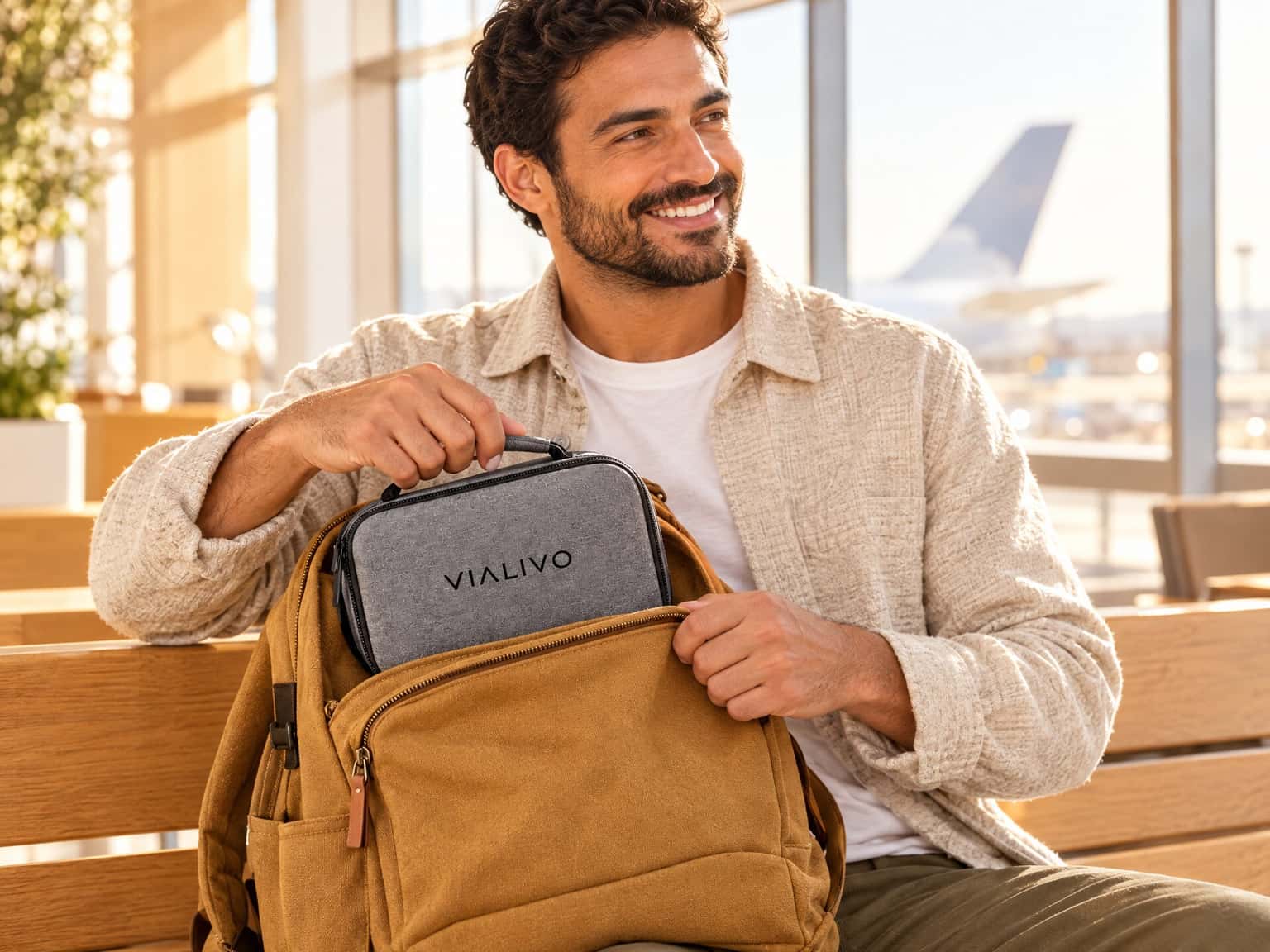
Every cooler on this site answers the same question with a different amount of equipment. The question is not where you are going. It is how long you will be away from a fridge, door to door, including the delay you did not plan for.
Answer that honestly and the choice makes itself.
The two answers
A working day, no plug: the Vialivo Ring. A round case with a freeze ring around a foam disc of vial slots. Freeze the ring for at least 8 hours, seat it, close the lid. Nothing to charge and nothing to plug in.
Longer than a day, or anywhere with power: the Vialivo Silo. A plug-in cooler with a fan and a digit display. It runs from the wall adapter and USB cable in the box, or from a power bank you bring yourself. It has no battery: it cools for as long as it has power and stops when it does not, so the hours question becomes a power question.
Each step up buys you time and costs you something: the Ring asks you to remember the freezer the night before, the Silo asks you to find a socket or carry a charged power bank.
Crate 10 comes with a gel stick you freeze. With no tested hold time, treat it as a way to move vials between fridges, not as a cooler for the day.
Be honest about the number
The common mistake is timing the journey instead of the trip. A two-hour flight is a seven-hour day once you count the drive to the airport, security, the gate, the flight, the baggage belt and the taxi. A cooler rated for the flight is not rated for the day.
Count from the last fridge to the next fridge. If you do not know when the next fridge is, buy for the longer number.
What we publish, and what we do not
This matters more than any of the advice above, so it gets its own section.
We publish a figure only when it has a source and comes with its conditions.
The Vialivo Ring is manufacturer rated for up to 8 hours with the ring frozen at least 8 hours and the outside air below 30 °C. That is the manufacturer's figure, not one we measured. Outside those conditions, do not count on the full 8 hours: a ring that spent less time in the freezer, or a hotter day, gives you less.
The Silo's page reads: Manufacturer rated 2–8 °C inside, while plugged in. That is the manufacturer's figure, not one we measured, and it does not say at what room temperature, so treat it as the best case, not a promise. There is no published runtime on a power bank: not a conservative estimate, not a range, not "all day": nothing. When we have a confirmed figure, it will appear on the product page with the conditions it applies to, and this guide will change with it.
Treat any hour figure without a stated outside temperature as marketing. That is why ours never appears without one.
Freezing the ring properly
A ring that spent two hours in the freezer is a cold ring, not a frozen one, and the Ring's rating assumes a frozen one.
- Freeze it for at least 8 hours, so it is solid all the way round.
- Seat it straight from the freezer and close the lid. Every minute it sits open on the counter comes off the end of your day.
- Keep vials in their foam slots. The foam is what keeps glass off the frozen ring; a vial wedged loose against it has the opposite problem to the one you are solving.
- Refreeze it at the other end if there is a freezer. Most trips are round trips.
Running the Silo
The digit display is the cooler's own. We have not checked it, or the manufacturer's rating, against an independent thermometer yet. If the number matters to you, put a small thermometer inside, run it for a day at home, and compare before you rely on it on a trip.
The Silo pushes heat out through a fan and a heatsink, so it works harder, and may not get as cold inside, in a hot room or a hot car. Give it shade and keep the fan clear, and do not wrap it in a bag while it is running.
If you run it from a power bank, charge the bank before you leave, and pack the adapter and cable in the same bag as the cooler. With no battery inside, a Silo on a flat power bank is just a box.
Cars are the hard case
A car parked in the sun is the hottest place most of these products will ever go. The cabin gets far hotter than the air outside it, and it does it quickly.
Nothing here is rated for a parked car, and we are not going to imply otherwise. Take it with you, or keep it in the footwell of a moving car with the air conditioning on: not the trunk, not the rear shelf, not the glovebox.
Flying
Both coolers go in your hand luggage. The hold is neither temperature-controlled nor somewhere you can reach, and a power bank for the Silo is not allowed there at all: in the United States, the FAA requires power banks to travel in carry-on bags only (faa.gov).
The Ring's frozen ring is screened like an ice pack. In the United States, the TSA allows frozen packs through the checkpoint when they are frozen solid, and medically necessary ones in any state if you tell the officer before screening (tsa.gov). Declare it at the checkpoint before your bag goes through rather than after.
Rules differ by country and change, so check the current one for the airport you are leaving from. In the United States, start with the TSA's special procedures page.
Back home
Once you are back at a fridge, the job changes from keeping vials cold to keeping them upright, labeled and in one place. See how to store peptides, or go straight to the Crate 10 and Crate 8.